EN
 HR
Artificial intelligence (AI) and sustainability, which is taken to a higher level with a holistic approach, are two of the most prominent topics.
At very interesting lectures, we learned useful information from excellent lecturers: Katie Gallus, Prof.Dr. Heinz – Dieter Quack, Deborah Rote, David Ruetz, Alex Brainbridge, Pieter Jordaan, Mary LI, Prf.Dr. Maja Gopel, Thom Arkestal, Angela Kraft. All these people are worth "googled", or asking AI about them. They are top experts in their field. It is a great pleasure to listen to them live.
Europe remains the most visited region in the world
Albania, the partner country of this year's ITB, made excellent use of the opportunity to position its offer in the right way and in the right place. Albania is the country with the largest increase in arrivals last year - as much as 80% more compared to the reference year 2019.
Both Bosnia and Herzegovina (+15%) and Serbia (+29%) grew very well compared to 2019.
Mediterranean Europe experienced growth of 7,3% between 2023 and 2024. Arrivals also increased in Andorra, Malta, Portugal and Turkey, with double-digit growth.
Northern and Western Europe grew in arrivals by 5.9 and 5,3%, while Denmark grew by as much as 17% and Luxembourg by 24% compared to 2019.
Europe, on the other hand, exceeded pre-pandemic international arrivals by 1% in 2024. 747 million arrivals were recorded last year.
When looking at the total tourist traffic (domestic and international trips), the distribution of the "cake" by region of the world is as follows:
North America accounts for 33% of total traffic, Europe 23%, Eastern Europe (outside the EU) 4%, Latin America 5%, the Middle East 6%, and the Far East 29%.
Online bookings continue to grow
Online booking trends are growing across all regions, most notably in the Far East, Europe and North America. Overall, this booking method is predicted to reach 66% of total bookings by 2027.
The most traveled European countries are Germany with 44 million passengers, Great Britain with 40, France with 34, Italy with 33 and Spain with 29 million passengers. Travelers travel an average of 3 and a half times a year and spend between 2,7 and 4.000 euros per year on travel.
European travelers use the following social networks the most when planning their trips: Instagram 70 – 79%, Facebook 57 – 68%, X 35 – 48%. They prefer locally sourced food and shopping and are increasingly purchasing trips that have a sustainability component.
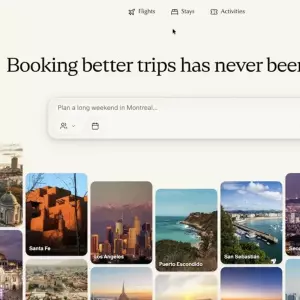
Artificial intelligence becomes a "travel assistant agent"
Artificial intelligence is increasingly used in travel planning and destination selection (65%), searching for flights to a destination (56%), researching possible activities at a destination (50%), and comparing destinations (45%). When using artificial intelligence, travelers consider confirmation of efficiency (38%), the ability to find the best deal for their desired trip (34%), an overview of all current prices (30%), and the ability to book directly (29%).
Consumption is growing
Total global tourism spending is expected to reach $5,5 trillion by 2025. The 12 most successful tourism countries in the world are: USA with $156 billion in revenue, Spain with $140 billion, China with $115 billion, France with $94 billion, UAE with $83 billion, Japan and Thailand with $61 billion each, Turkey and Italy with $59 billion each, Great Britain and Germany with $47 billion each, and Saudi Arabia with $45 billion in revenue.
Train travel hit
In terms of travel sustainability, a big surprise for many is the rapid growth of train travel. Guided tours, visits to museums and cultural monuments, national parks, attractions are also on the rise, and all of these phenomena are ahead of air travelers in terms of numbers. Significantly smaller, but still growing, are interests in adventure travel, duty-free shopping, luxury hotels, food and drink, health tourism, theme parks and spas.
The most important trends in tourist travel
The five most prominent trends in tourism are: a step towards impressive experiences, always acting with the will to have a positive impact (on the environment, ecosystem, local community), shared (common) values bind the long-term creation and preservation of these values, "people-centric" (people at the center) business puts the community first.
Is human alienation being replaced by a virtual assistant?
The desire for generative (creative) artificial intelligence is somewhat frightening. It seems that modern people are increasingly alienated and want to communicate with artificial intelligence that pleases them. For example, 42% of AI users want voice communication to search for personal, personalized information and recommendations, 30% of them want to talk to artificial intelligence while driving in an autonomous vehicle, 42% of them want a robot to help them with check-in and room service at a hotel, 30% want to search for brands that track emotions and personalize the experience, and 22% of AI users would prefer to have a microchip implanted in their finger to make communication with artificial intelligence even easier. At the same time, generations X and baby boomers are significantly less dependent on consultations with artificial intelligence than generations Millennials and "Z". This is quite natural given their age.
What "gives hope" is the fact that 31% of generation "Z" buys trips physically in an agency, 51% of that generation expresses a willingness to pay up to 30% higher prices for trips that have elements of sustainability and 67% of them are willing to pay more for relaxing features on the trip.
In the next installment, more about the implementation of an "artificial agent", or an assistant travel agent in the form of artificial intelligence.