What do we actually want from Croatian tourism?

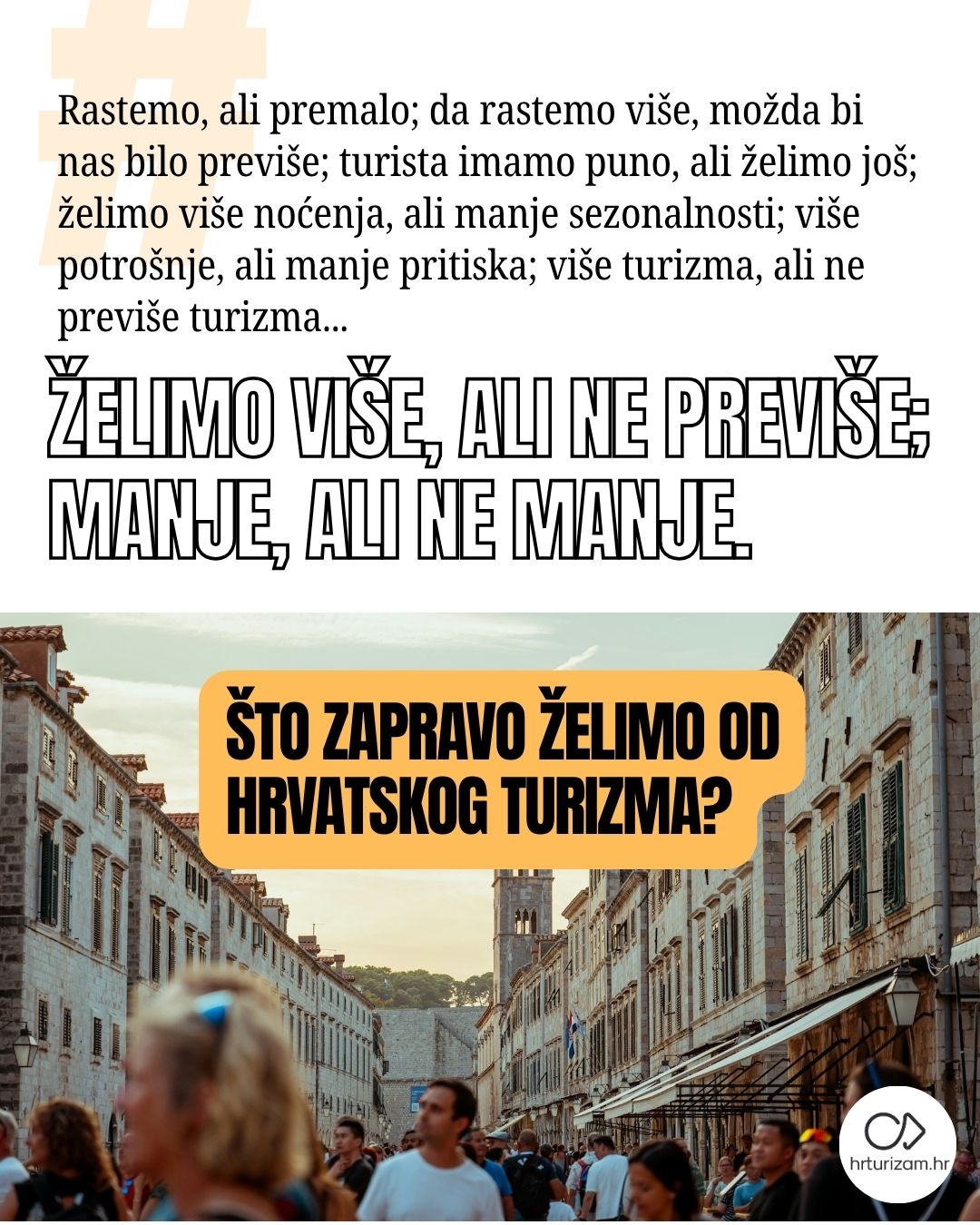
We want more, but not too much; less, but not less.

Photo: Stavrialena Gontzou, Unsplash

Author  Goran Rihelj

16. September 2026.

"They are small, but they are big, or rather, I mean, they are no longer small, but they are big enough not to be small." is a legendary sentence from Smogovci that almost perfectly describes the way we have been talking about the results of Croatian tourism for years.

Namely, from January to the end of August, Croatian tourism achieved a growth of 1% in both arrivals and overnight stays compared to the same period last year.

And again: it's not good. When we stagnate, it's not good. When we grow by one percent, we compare ourselves to countries that are growing more and again conclude that something is wrong. If we had experienced a decline, of course it wouldn't be good.

It's like we're stuck in our own tourist version of Smogovci: we are growing, but not enough; if we were to grow more, there might be too many of us; we have a lot of tourists, but we want more; we want more overnight stays, but less seasonality; more consumption, but less pressure; more tourism, but not too much tourism... we want more, but not too much; less, but not less.

What do we really want? Do we have a clear definition of what we consider to be the success of Croatian tourism? Especially at the level of the destination itself? 

By what criteria do we actually conclude whether the result is good or bad? What have we defined as the goal of Croatian tourism? Do we want more tourists? Do we want to maintain the existing volume, but increase consumption and added value? Do we want fewer guests in July and August, and more in the rest of the year? Less tourist pressure in the busiest destinations, and more traffic in continental Croatia? Higher productivity? Higher revenues without additional volume growth? Greater satisfaction of the local population?

What do we really want?

While we don't have answers to these questions, almost every tourism result can be viewed as both a success and a failure at the same time.

This text is not really a reaction to the 1% growth itself, nor an attempt to declare the tourism result good or bad. It is more a reflection on the comments that appear every time we publish new tourism statistics. If we are growing, the question is why we are not growing more. If we are stagnating, we wonder why there is no growth. If we were falling, we would talk about a bad season.

And this discussion brings me back to a much more important question: Do we even have a predefined criterion by which we will know whether Croatian tourism has achieved a good result?

Arrivals and overnight stays are important indicators of market activity, but they do not by themselves tell us whether Croatian tourism is more successful. They tell us how many people came and how many stayed. They do not tell us enough about how much value tourism has created, where it has created it, when it has created it, and at what cost to the destination.

If we are talking about sustainability, year-round tourism, higher added value, quality of life for local residents, and reduction of seasonality, then this is exactly what we need to turn into measurable KPIs.

Because if our strategic goal is to reduce seasonality, then the drop in overnight stays in August with strong growth in October may not be a bad result - but a success. If we want a higher value per guest, the stagnation of the number of arrivals with the growth of tourist consumption can be an excellent result. If we want to relieve a certain destination, even a drop in physical traffic can be part of successful tourist development.

The problem with Croatian tourism may not be one percent growth. The problem is that we still don't have a clear enough answer to a much simpler question: what do we actually want?

In the last two texts, I touched on essentially the same problem from two different angles.

/ / / "As a hotelier, I'm not interested in these statistics." And I should be.

/ / / "That's not my topic." Maybe that's exactly the problem with Croatian tourism

First through reaction "As a hotelier, I'm not interested in these statistics", and then through the even more common one: "That's not my topic." Perhaps part of the answer lies precisely in these sentences. If the profession does not follow the bigger picture, if each sector only looks at its own results, and if we do not have a common answer to the question of where the destination is heading, it is difficult to expect that we will have common KPIs against which to measure the success of Croatian tourism.

Until we define that, we will continue to have the same debate about arrivals and overnight stays every year. And the profession will be able to declare each result either good or bad, depending on which angle they look at it from that day.

And here we come to the question again governance, respectively destination development management.
White and brown minimalist animal deer and nature instagram post 2 2

Here too, it is important to separate two things. One is politics, and the other is the management of growth and development. Politics has its role in determining the development direction, but after that comes management, business processes, responsibility, coordination, deadlines and KPIs. A political decision can define direction, but it cannot replace governance.

That's why when I talk about governance, I'm not talking primarily about party politics, but about a much more concrete issue: Who manages development, where does it want to go, how does it make decisions, how does it coordinate different interests and according to what indicators does it measure the result?

Because tourism is not a separate system that exists on its own.

That's exactly why I wrote earlier that development without management is not development. Governance is not a bureaucratic word, but a question of the destination's ability to coordinate the economic benefits of tourism, investments, space, infrastructure and the interests of the local community. If the destination does not manage its own development, development will very quickly begin to manage it.

/ / / Development without management is not development. That is why "governance" is the key to the development of tourism

And that's why it makes no sense to look for one universal KPI for all of Croatia. Each destination must know for itself what it wants to achieve.

Dubrovnik does not have the same challenges as Vinkovci. Rovinj does not have the same development goals as Zagreb. A destination facing high tourist pressure may want to reduce physical volume in the peak season, increase value per guest and decongest the space. Another destination may just need more guests, more investment, higher occupancy and stronger tourist traffic.

That's why KPIs must come from visions for the development of a specific destination, and not just from the national table of arrivals and overnight stays.

Only when a destination says where it wants to be in five or ten years can we seriously talk about what needs to be measured. Is it revenue per guest, added value, employment, productivity, seasonality, spatial dispersion of tourists, resident satisfaction, quality of life, investments, hotel occupancy or something else.

Not every growth is automatically a success. Just as not every decline is automatically a failure. It all depends on the goal.

And here we return to the profession again.

The profession cannot simultaneously demand better quality destination management and view itself as someone who stands on the sidelines and only comments on the results. Hoteliers, caterers, agencies, rental companies and other tourism stakeholders are not outside the management system - it is their representatives who make up the majority of members of local Tourist Councils.

So, the profession is not an observer. The profession sits at the table where decisions are made. And that's why when we say that a destination does not have a clear direction, does not have defined KPIs, or that it is not managed well enough, part of the responsibility necessarily lies with the profession itself.

After all, Do you know who sits on your destination's Tourist Board?

How often do we as a profession ask ourselves who represents us there, what positions they hold, and what decisions they make? This is one of the key places where decisions are made about the work of the tourist community and where they participate in guiding destination development.

We cannot be part of the decision-making system, and then, after the publication of tourism results, position ourselves solely in the role of commentator and say: “that is not my topic”. The tourist board should not be just a marketing organization, but one of the key tools destination management, that is, development according to the DMMO concept in which the emphasis is no longer only on marketing, but precisely on management -stakeholder coordination, development management and achievement of jointly defined goals. 

But the tourism community must also have human, financial and other resources to be able to engage in development and management. Which many people don't have today. Because logically, if we expect serious destination management from tourist boards, we must provide them with adequate capacities for such a role.

But expertise alone is not enough.

Finally we return again to the local populationA tourist destination is primarily a city, municipality or area where someone lives. The local community chooses the people to whom it entrusts the management of development, participates in public processes, reacts to decisions and ultimately feels their consequences.

That is why we cannot constantly look elsewhere for responsibility for the direction of tourism development.

It's all up to us. On institutions. On destinations. On tourist boards. On the profession. On entrepreneurs. And on the local population. So the next time we comment that one percent growth is too low, that stagnation is not good, or that some other country is growing faster, perhaps we should first ask a much more important question: What have we decided we want to achieve?

Because it's easiest to comment on the result. It's much more difficult to define the goal, manage the process, and take responsibility for it. And without that, there can be no serious development of a destination.

So let's start from the beginning: what do we actually want?


*** And finally, the same question: What do you actually want from the media you follow? Quality content, analysis and context do not happen by themselves. Media also need to make money in order to be quality, independent and sustainable in the long term. Otherwise, click logic will always trump quality.

Subscription to HrTurizam is an investment in the context and understanding of tourism. 8,33 euros per month or one coffee with milk per week.

Author  Goran Rihelj

16. September 2026.